



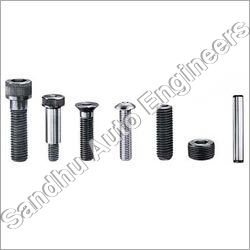
Socket Head Screws
300 INR/Piece
Product Details:
- Shape Cylindrical Head
- Diameter M3 - M20
- Thickness As per size
- Grade 8.8 / 10.9 / 12.9
- Surface Treatment Other
- Drive Type Hex Socket
- Head Type Socket Head
- Click to View more
X
Socket Head Screws Price And Quantity
- 300 INR/Piece
- 100 Piece
Socket Head Screws Product Specifications
- 8.8 / 10.9 / 12.9
- 5-20 Grams (g)
- Cylindrical Head
- As per size
- M3 - M20
- 800 - 1200 MPa
- Hex Socket
- Bolt/Screw
- Yes
- Other
- High Strength, Precision Fit
- Socket Head Screws
- HRC 32-40
- For Industrial
- Metric / UNC / UNF
- ISO 4762 / DIN 912
- High
- Socket Head
- Other
- High Load Capacity
- As per DIN/ISO standard
- Smooth / Polished
- ±0.02 mm
- Mechanical, Engineering, Industrial
- Box / Bulk
- Yes
- Black / Silver / Custom
- Right Hand
- Up to 300C
- 6 mm - 120 mm
Socket Head Screws Trade Information
- 600 Piece Per Month
- 10-15 Days
- North America, Eastern Europe, South America, Australia, Central America, Western Europe, Middle East, Asia, Africa
- All India
Product Description
We have established a strong foothold in the international market by manufacturing and exporting a superior range of Socket Head Screws. To meet the diverse needs of the clients, we offer these screws in various lengths, diameters and dimensions to opt from. Our Socket Head Screws are made by a team of skilled professionals using quality materials, following the norms and guidelines laid down by the industry. In addition, our screws cater to the needs of various automotive and engineering industries.
Specification
| Type Of Bolts | Socket Set Screw |
| Surface Finishing | Polished |
Features:
- Durable
- Rust resistance
- Superior finish
Further Details:
- Shoulder Screws
- Flat Head Socket Screws
- Button Head Socket Screws
- Socket Set Screws
- Pressure Plugs
- Dowel Pins
Length Range: 20MM to 1000MM
Grade: SS, 10.9, 12.9
Precision Engineered for Industrial Demands
Boasting a tight tolerance of 0.02 mm and superior hardness, these socket head screws ensure a precision fit for critical assemblies. Their cylindrical design and metric or imperial threading facilitate reliable and consistent fastening in high-stress and high-load environments, making them a staple in mechanical and engineering sectors.
High Strength and Corrosion Resistance
Manufactured from premium-grade alloy steel and hardened to HRC 32-40, these screws offer exceptional tensile strength (800-1200 MPa) and high load capacity. The smooth, polished finish and corrosion-resistant properties make them ideal for use in demanding conditions, reducing maintenance and prolonging lifespan.
Adaptable Applications and Standard Compliance
Conforming to ISO 4762 and DIN 912 standards, these socket head screws are suitable for various industrial, mechanical, and engineering applications. The hex socket drive enables easy installation with standard tools, while options in metric, UNC, and UNF threads enhance their adaptability for different global requirements.
FAQ's of Socket Head Screws:
Q: How are socket head screws typically used in industrial or mechanical applications?
A: Socket head screws are mainly used to securely assemble parts in industrial, mechanical, and engineering settings. Their high load capacity and precision fit make them ideal for machinery, structural frames, and other assemblies where strength and reliability are essential.Q: What standards do these socket head screws adhere to, and why is it important?
A: These screws conform to ISO 4762 and DIN 912 standards, ensuring they meet rigorous global requirements for dimensions, strength, and quality. This compliance guarantees compatibility and safety in critical applications.Q: When should I choose high-grade screws like 8.8, 10.9, or 12.9 for my project?
A: You should select higher-grade screws when your application demands increased tensile strength and hardness, such as in high-load or high-stress environments. Grade 10.9 and 12.9 screws are best for heavy machinery and equipment, while 8.8 is suitable for general industrial uses.Q: Where can these socket head screws be applied most effectively?
A: These screws excel in mechanical engineering, industrial manufacturing, automotive assembly, and equipment repairs. Their corrosion resistance and high strength make them suitable for indoor and outdoor settings exposed to heavy use or environmental elements.Q: What is the process for ensuring a precise fit and durability in these screws?
A: These socket head screws are manufactured with tight tolerance (0.02 mm) and undergo hardening processes to achieve HRC 32-40. This ensures dimensional accuracy, superior wear resistance, and reliable performance under load.Q: How does the corrosion resistance benefit industrial users?
A: Corrosion resistance extends the life of the screws in harsh or wet environments, minimizes maintenance, and preserves structural integrity over time, making them ideal for demanding industrial applications.Q: What are the main advantages of using a hex socket drive on these screws?
A: The hex socket drive allows for greater torque transfer and minimizes the risk of slippage or stripping. It also enables easy assembly and disassembly in confined spaces with standard hex keys or Allen wrenches.Tell us about your requirement

Price:
Quantity
Select Unit
- 50
- 100
- 200
- 250
- 500
- 1000+
Additional detail
Mobile number
Email

Other Products in 'Industrial Fasteners' category

Overseas Office :-
151, Whitewell Dr. Brampton,
Canada, On LP6 1LU
Factory Address :-
Industrial Area A,
Link Road, Ludhiana
Contact Us

- B-XXI, 1228, Dholewal Link Road, Ludhiana - 141003, Punjab, India
- Phone : 08045802159
SANDHU AUTO ENGINEERS
GST : 03ALNPS8743C1ZX
GST : 03ALNPS8743C1ZX

- Mr Davinder Sandhu (Proprietor)
- Mobile : 08045802159
- Send Inquiry
 Send Inquiry
Categories
 Send Inquiry
 Send SMS
SANDHU AUTO ENGINEERS
All Rights Reserved.(Terms of Use)
Developed and Managed by Infocom Network Private Limited.
Developed and Managed by Infocom Network Private Limited.

